


By Marc Kavinsky, Lead Editor at IoT Business News.
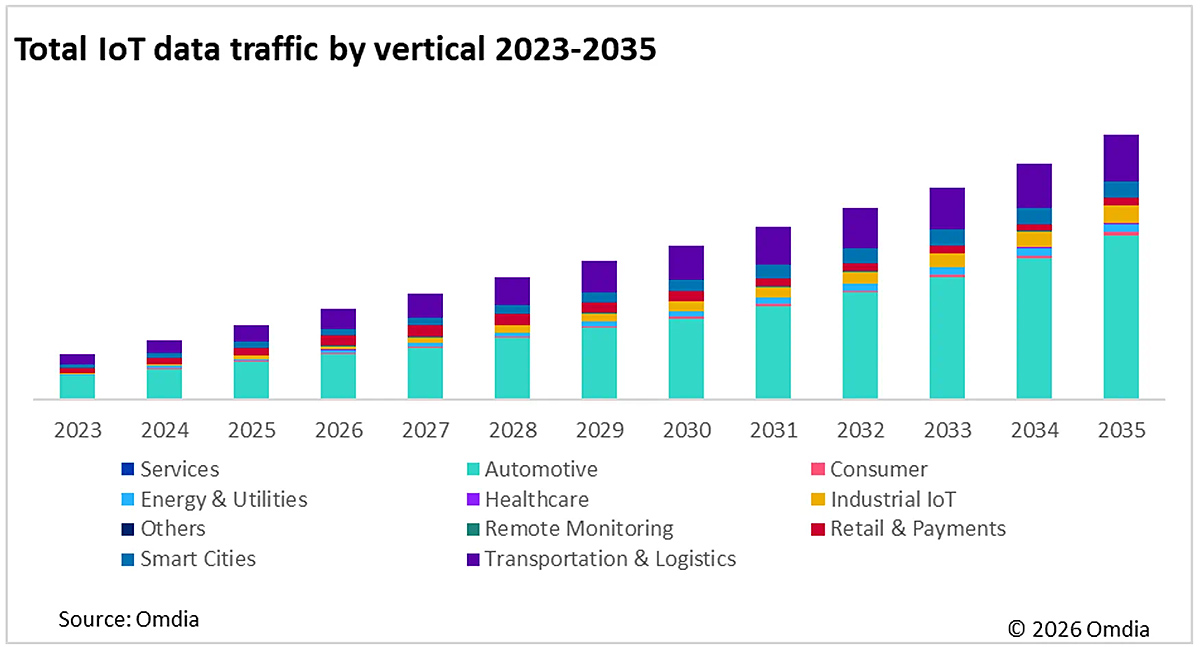
Omdia forecasts cellular IoT data traffic will climb to 218.6 exabytes by 2035, with automotive—particularly infotainment and OTA updates—accounting for the majority of bytes and shaping how 5G and edge processing are prioritized.
For years, the cellular IoT conversation has been dominated by connection counts: how many devices, which radio technologies, and what it costs to keep endpoints online. But as deployments mature, network planning and product strategy are increasingly constrained not by how many SIMs are active, but by how much data the “IoT” label actually pushes—especially when video and software delivery enter the mix.
New research from Omdia puts a hard number on that shift. The firm expects data traffic from cellular IoT connections to reach 218.6 exabytes (EB) by 2035, driven by demand for data that can be analyzed to improve operational efficiency and open new revenue streams.
What makes this forecast stand out is not the headline exabyte figure—it’s the composition. Omdia’s analysis positions the automotive sector as the dominant source of cellular IoT data traffic, powered by infotainment services (including video and audio streaming) and firmware over-the-air (FOTA) updates. In Omdia’s forecast window from 2025 to 2035, automotive traffic rises from 30.7 EB to 135.4 EB.
That framing matters because it highlights a persistent reality: in cellular IoT, a relatively small set of high-bandwidth use cases can outweigh an enormous base of low-throughput sensors. Many enterprise IoT deployments are designed around kilobytes per day; connected vehicles can generate orders of magnitude more traffic per device when streaming and software maintenance become default expectations. In practical terms, this suggests that cellular IoT data growth is likely to track consumer-facing vehicle experiences and software-defined vehicle operations at least as much as classic industrial telemetry.
Omdia Senior Analyst Alexander Thompson connects the traffic curve directly to vehicle feature adoption, stating:
“The rising number of vehicles with smart features, particularly infotainment, will cause cellular IoT data traffic to boom over the next decade. Other video-based use cases will also generate significant amounts of data.”
Transport and logistics, meanwhile, is identified as the next major contributor. Omdia adds an important qualifier: beyond 2025, all other sectors combined are expected to contribute less than 29% of total cellular IoT traffic. The implication for IoT professionals is clear—verticals that historically defined cellular IoT volumes (utilities, smart city sensing, industrial monitoring) may remain strategically important, but they will not be the primary drivers of network byte growth in this model.
Why bytes, not devices, will drive architecture decisions
Omdia’s research also points to emerging traffic sources that did not register at scale several years ago. The firm highlights “remote vision” (adding cameras to devices ranging from delivery robots to industrial machinery) and “agentic AI,” described as driving growth in peer-to-peer machine traffic. Omdia Practice Lead Andrew Brown argues these trends are increasing demand for greater edge processing power and accelerating 5G adoption.
One operational takeaway is that the industry’s definition of “IoT traffic” is broadening from periodic uplinks to continuous media streams and more dynamic machine-to-machine interactions. If more endpoints become camera-equipped or support richer autonomy features, enterprises and integrators will face a double constraint: higher sustained uplink/downlink usage and tighter latency expectations. That combination tends to push architects toward more local processing—because moving every raw frame to the cloud is expensive, and in many settings impractical.
Regional gravity: Asia & Oceania leads early traffic share
Omdia also emphasizes geography. Asia & Oceania is expected to generate the highest amount of cellular IoT data traffic, accounting for 50.6% of global cellular IoT traffic in 2025. Omdia links the region’s position to early technology adoption and a significant installed base of video cameras—two factors aligned with the report’s broader thesis that video and richer data types are becoming central to cellular IoT growth.
For connectivity providers, this is less about a generic “APAC growth story” and more about where capacity planning pressure shows up first. If a large share of traffic originates where video-capable deployments are already dense, it reinforces the need for differentiated service offerings—potentially including traffic management, edge-aligned architectures, and commercial models that better match high-bandwidth IoT profiles than traditional per-SIM pricing.
What OEMs and integrators should do with this forecast
For automotive OEMs and their ecosystem partners, Omdia’s numbers underscore that infotainment and OTA are not side workloads—they are forecast to be the primary cellular IoT traffic engines. That elevates the importance of designing update strategies, content delivery approaches, and in-vehicle data handling with network impact in mind, not as an afterthought.
For logistics solution providers, the “next major sector” label is a signal that richer tracking and operational visibility—potentially incorporating more imagery and higher-frequency data—may increasingly define competitiveness, with direct consequences for connectivity design and device power budgets.
And for enterprises outside automotive and logistics, the report’s sector split is a reminder that low-data IoT remains a different business and engineering problem than high-bandwidth cellular use cases. Even as headline exabytes surge, many industrial deployments will continue optimizing for coverage, battery life, and lifecycle management—while a smaller set of applications forces the ecosystem to rethink capacity, edge compute placement, and the commercial structure of cellular IoT connectivity.

Leave a Reply