

By Marc Kavinsky, Lead Editor at IoT Business News.
Littlebird says it will work with Lacuna Space to add satellite-enabled IoT connectivity to its Precision+™ safety network, extending a family-focused wearable experience beyond areas well served by terrestrial infrastructure.
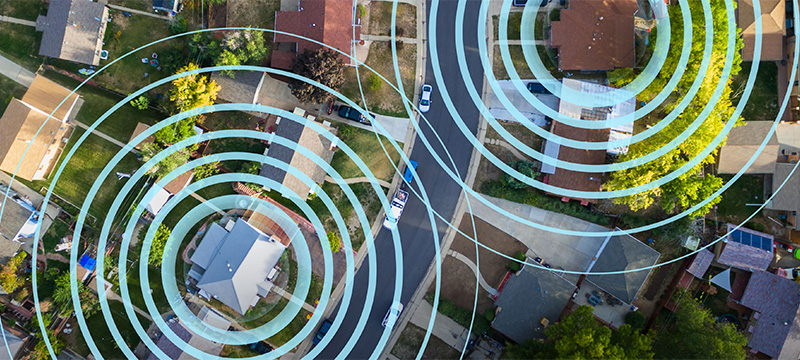
For consumer safety wearables, the hardest engineering problem is rarely the wristband itself. It’s the connectivity envelope: maintaining dependable, low-power signaling when users move between dense neighborhoods, indoor spaces, suburban edges, and the rural “dead zones” where cellular coverage becomes patchy and community networks thin out.
That’s the gap Littlebird is trying to narrow with a new strategic partnership with Lacuna Space. Littlebird, which positions its offering as a screen-free safety wearable and an underlying “connected safety operating system,” said it will explore how Lacuna Space’s satellite-enabled IoT connectivity can extend and strengthen its Precision+™ safety network across places where ground infrastructure is limited.
The announcement is notable less because it adds “satellite” to a product narrative—many IoT vendors now do—and more because of the specific layering Littlebird is pursuing: a multi-network approach that already includes Amazon Sidewalk and “telco carriers” alongside other terrestrial connectivity relationships. Littlebird said it was among the first consumer safety brands to deploy a wearable on Amazon Sidewalk, the low-power community network based on Bluetooth Low Energy and LoRa that Amazon says reaches more than 90% of the U.S. population.
Why this is different from a typical satellite IoT tie-up
Most satellite-IoT announcements focus on connecting sensors in remote industrial settings, or on adding a satellite modem as a premium add-on for guaranteed coverage. Littlebird’s framing is different: it is explicitly building a “layered infrastructure” model, treating satellite as one additional pathway in a broader Precision+™ network that aims to combine multiple signal routes and “intelligent context” to improve continuity.
That approach matters because it shifts the value proposition from raw coverage to operational resilience. When a safety product depends on any single bearer—cellular, Bluetooth-to-phone, or even a single LPWAN—coverage holes turn into user trust issues. A multi-path design can reduce single points of failure, but it also raises an important implementation reality: the product experience becomes a network-selection and state-management problem as much as a hardware problem.
Littlebird’s partnership with Lacuna Space targets that resilience layer. Lacuna Space describes its service as direct-to-device IoT connectivity using ultra-low-power protocols optimized for battery-powered devices, built on its proprietary LoneWhisper® technology. In the release, Lacuna Space also highlights extending networks such as Amazon Sidewalk to rural areas—an explicit hint at how a Sidewalk-first device strategy could reach beyond Sidewalk’s terrestrial footprint without forcing families into a cellular-only model.
What IoT professionals should take away
For OEMs building wearables and trackers, the Littlebird-Lacuna Space collaboration is a reminder that “coverage” is now a composite architecture decision. Combining a community LPWAN (Sidewalk), satellite-enabled links, and carrier relationships implies that device behavior, cloud routing, and the customer promise must be designed together. Even without new technical details disclosed, a multi-network strategy typically requires careful policies for when a device uses which path, how frequently it reports, and how it handles intermittent connectivity—choices that directly impact battery life and user expectations.
Connectivity providers and satellite operators should also note the positioning: consumer safety is being approached with infrastructure pragmatism, not with a single-network bet. That could open the door to more “coverage mosaics,” where satellite is not a standalone product but a backstop integrated into a broader connectivity stack.
System integrators and platform players may see a familiar enterprise pattern emerging in a consumer category: a shift toward interoperability across heterogeneous networks. Littlebird explicitly frames its network-first strategy as not being dependent on any single mode of connectivity, but instead built on interoperability across “trusted infrastructure layers.”
From safety wearables to broader chain-of-custody concepts
Beyond the connectivity expansion, Littlebird also points to a longer-term architecture: a patented, multi-modal “trust and chain-of-custody infrastructure” intended to validate situational awareness across layered, context-based networks over time. The company says it is starting with children, but intends the architecture to expand to other connected care and mobility applications, including pets, livestock, and robotics.
Here, the satellite angle is not just about reaching remote terrain; it can also be read as an effort to standardize “presence” and “handoff” events across environments where there is no guarantee of terrestrial backhaul. In practical terms, if Littlebird can make multi-path connectivity and contextual validation work in a consumer wearable—where cost, size, and battery constraints are unforgiving—it may strengthen the case for similar designs in adjacent tracking and care markets.
For the IoT ecosystem, the broader signal is clear: as LPWAN community networks mature and satellite IoT becomes more accessible, the next wave of product differentiation is likely to come from how intelligently vendors blend networks, not from the existence of any single bearer. Littlebird’s partnership with Lacuna Space is an example of that integration-first playbook moving into mainstream family safety.

Leave a Reply